
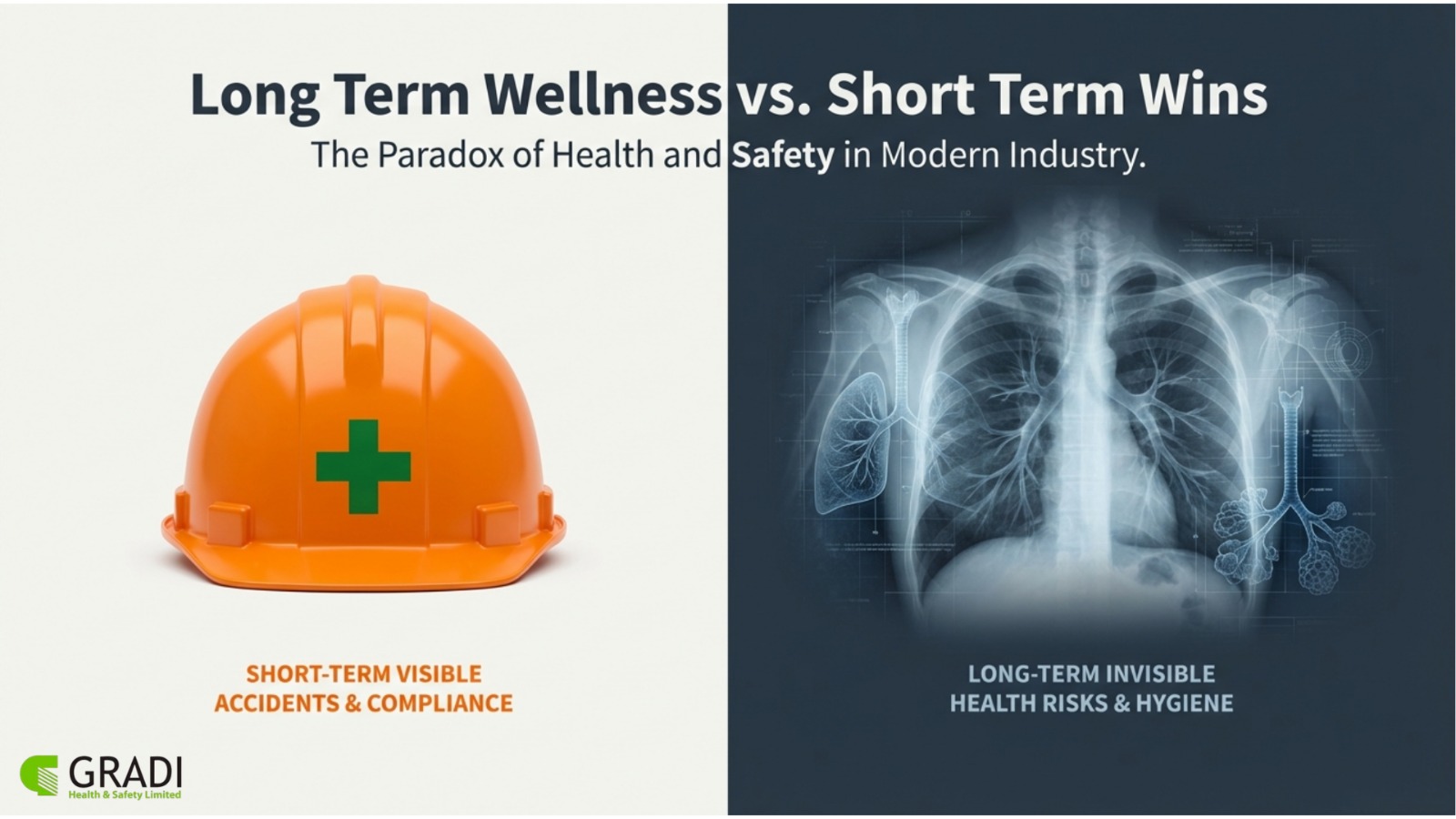
The “Zero Harm” Illusion
Imagine a factory floor celebrating “5 Million Hours LTI Free.” There is cake in the breakroom, bonuses for the managers, and a shiny plaque on the wall. The safety record looks impeccable.
Yet, in that same factory, silica dust is settling in the lungs of workers, a solvent is slowly sensitizing their skin, and the hum of machinery is permanently damaging their hearing.
The plaque on the wall celebrates a Short Term Win—the absence of accidents. But it completely ignores Long Term Wellness—the presence of disease.
This is the central paradox of modern industry: We are experts at preventing the loud, visible accidents that happen now (slips, trips, falls), but we are failing to prevent the silent, invisible diseases that kill later.
The Psychology of the Paradox
Why do we obsess over safety statistics while neglecting health? The answer lies in human psychology, specifically the Availability Heuristic.
Accidents are dramatic. A fall from height or a machinery injury triggers an immediate emotional response and a swift investigation. It is a “System 1” event—fast, visible, and urgent.
Occupational diseases, however, are quiet. Silicosis doesn’t bleed. Noise-induced hearing loss doesn’t require an ambulance. Because these health threats lack immediate drama, they are pushed to the background.
We prioritize the “Short Term Win” of skipping a respirator to finish a job faster, discounting the “Long Term” cost of a cancer diagnosis 20 years from now.
We have built a culture of “Compliance Theater,” where we check boxes to look safe, without ever verifying if we are actually healthy.
The Reality Check: 88% vs. 11%
If you think “Safety” is the biggest killer, look at the data.
According to the International Labour Organization (ILO), approximately 88% of work-related deaths are caused by diseases, while only 11% are caused by accidents.
Let that sink in. We spend the majority of our budget, training, and inspection time focusing on the 11% (Safety), while the 88% (Health) continues to claim lives in the shadows.
This is not just a tragedy; it is a Competence Gap. Most safety professionals, doctors, and inspectors are simply not trained to see the invisible.
The Solution: Enhancing Capability with OHTA
To shift from Short Term Wins to Long Term Wellness, we must upgrade our capability. General safety knowledge is no longer enough. We need the technical precision of Occupational Hygiene, delivered through the OHTA (Occupational Hygiene Training Association) framework.
Here is how three specific modules bridge the gap:
1. Waking Up: OHTA 201 (Basic Principles of Occupational Hygiene)
You cannot fix what you cannot see. OHTA 201 is the awakening. It shifts a professional’s mindset from “walking past” hazards to “anticipating” them.
- It moves the conversation beyond “Is it safe?” (will I get hurt today?) to “Is it healthy?” (will this kill me in 10 years?).
- It provides the foundation to recognize the chemical, physical, and biological agents that standard safety checklists often miss.
2. Understanding the Enemy: OHTA 507 (Health Effects of Hazardous Substances)
This module is critical for Medical Doctors, Safety Specialists, and Safety Managers. Too often, occupational diseases are misdiagnosed. A doctor might treat a worker’s dermatitis as “eczema” or their asthma as “bronchitis,” completely missing the link to workplace chemicals. OHTA 507 teaches Toxicology. It explains the ADME principle (Absorption, Distribution, Metabolism, Excretion)—how toxins enter the body and which organs they attack.
- For the Doctor: It means accurate diagnosis and saving a life before it’s too late.
- For the Manager: It transforms a vague “dust problem” into a “carcinogen problem,” creating the moral urgency needed to act.
3. Killing the Risk: OHTA 505 (Control of Hazardous Substances)
This is the essential tool for Safety Specialists, Regulators, and Engineers. The “Short Term Win” is handing a worker a dust mask. It’s cheap, visible, and quick. But masks leak, clog, and fail. OHTA 505 teaches Engineering Control—how to design ventilation systems that capture the hazard at the source.
- It moves the industry from “Managing Exposure” (hoping the PPE works) to “Eliminating Risk” (designing the hazard out). This is the only path to true Long Term Wellness.
Conclusion: The Choice is Yours
The industry is at a crossroads. We can continue to chase the illusion of safety through LTI (Lost Time Injury) statistics, or we can invest in the reality of health through competence.
Healthy workers are a company’s greatest asset. Protecting them from the “Long Tail” liability of occupational disease requires more than good intentions; it requires technical skill.
Don’t just be a Safety Professional. Be a Health Protector.
Ready to equip yourself with the knowledge to see the invisible?
Join the 2026 Gradi Training Calendar for OHTA 201, OHTA 507, and OHTA 505.
📧 Contact us at: info@gradihs.com
📞 Call us: +234 816 471 0175