
The Statistic We Can’t Ignore It is easy to think of asbestos as a problem of the past—a material banned and forgotten. But the numbers tell a different, more urgent story.
Globally, asbestos-related diseases still claim an estimated 255,000 lives every year, according to the latest data from the International Labour Organization (ILO). In the UK alone, the Health and Safety Executive (HSE) confirms that asbestos remains the single greatest cause of work-related deaths.
This isn’t ancient history. It is happening right now—in buildings we renovate, factories we maintain, and schools we upgrade.
Why “Legacy” Asbestos is the Real Threat While many countries have banned new uses of asbestos, the “legacy” risk is massive. The World Health Organization (WHO) warns that millions of tons of asbestos remain hidden in buildings constructed before the 1990s. It sits in ceiling tiles, pipe insulation, and wall panels, often harmless until it is disturbed.
The danger doesn’t come from the asbestos sitting there; it comes from the accidental disturbance—the drill hole, the demolition, or the maintenance check that releases invisible fibers into the air.
The 20-Year Mistake The most terrifying aspect of asbestos is its patience. Diseases like mesothelioma (a cancer of the lining of the lungs) and asbestosis (scarring of the lungs) have a latency period of 20 to 50 years.
- A mistake made on a job site today won’t be felt tomorrow.
- It will be felt decades from now, when you or your colleagues should be enjoying retirement.
- The WHO states there is no known safe level of exposure. Once those fibers are inhaled, the clock starts ticking.
Protecting More Than Just Yourself When you train in asbestos management, you aren’t just protecting yourself. You are protecting the families of every worker on your site. Asbestos fibers can cling to work clothes and be carried home, exposing spouses and children to “take-home” risks that can be just as deadly.
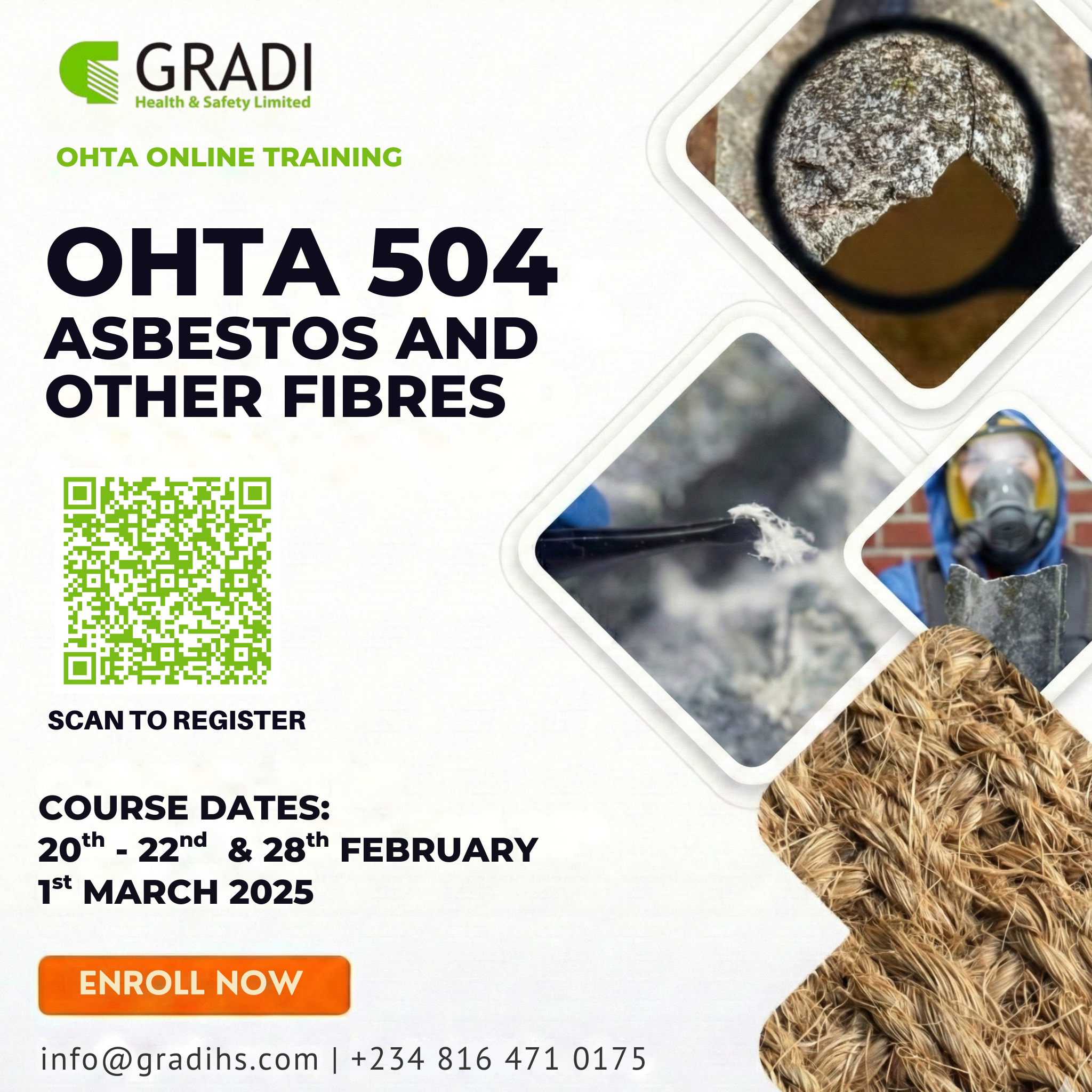
Your Role as a Safety Leader This is why OHTA 504 is critical. It is not just about passing an exam; it is about developing the “eyes” to see the invisible risk.
In our upcoming course, we move beyond the basics to cover:
- Identification: Spotting the likely locations of asbestos before work begins.
- Measurement: Using scientific sampling to quantify the risk.
- Control: Implementing strategies that ensure fibers stay out of the air and out of human lungs.
Join the Fight for Safer Workplaces Don’t let ignorance be the reason someone gets sick 20 years from now. Equip yourself with the knowledge to stop the silent killer in its tracks.
- Course: OHTA 504 – Asbestos and Other Fibres
- Dates: February 20th , 21st, 22nd, 28th & March 1st, 2026
- Mode: Online (Live Virtual Class)
- Registration link: OHTA 504 – Asbestos and Other Fibres
Secure your place today. 📩 Email: info@gradihs.com 📞 WhatsApp: +234 816 471 0175